
![30+ 4-Day Work Week Statistics & Facts [2026]](https://jobera.com/resources/wp-content/uploads/2024/03/4-day-workweek.webp)
What if you had an extra day each week?
According to the latest statistics, 66% of employees are attracted to job opportunities with a shorter work week.
78% of employees believe that a shorter workweek improves their work-life balance.
And employees who had a 4-day workweek reported lower stress levels and higher job satisfaction.
As of 2023, 33% of organizations offer a 4-day, 40-hour work week.
Ready for a work week makeover? Uncover the statistics behind the 4-day revolution.
Top 4-day work week statistics: Editor’s Pick

- 56% of employees would prefer working a 40-hour work week in 4 days instead of 5 days. [2]
- After the switch to a 4-day workweek, employees in a study took 25% fewer sick days. [9]
- Microsoft Japan implemented a 4-day workweek experiment and saw a 40% boost in productivity compared to the previous year. [5]
- 40% of employees worried about their workload becoming unmanageable within a shorter workweek. [10]
- 46% of HR professionals are concerned about coordinating schedules and managing coverage during the transition into a 4-day work week. [10]
- Studies suggest a 4-day workweek could lead to increased employment opportunities and improved work-life balance in the future. [13]
General 4-day Work Week Statistics
As of 2023, 33% of organizations offer a 4-day, 40-hour work week. [1]
Only 15% of companies are offering employees 4-day work weeks of 32 hours or less per week. [1]
56% of employees would prefer working a 40-hour work week in 4 days instead of 5 days. [2]
58% of employees confirmed that they would choose a 4-day workweek over a pay raise. [3]
The 4-day work week has been successfully implemented in Iceland, Germany, and Spain. [4]
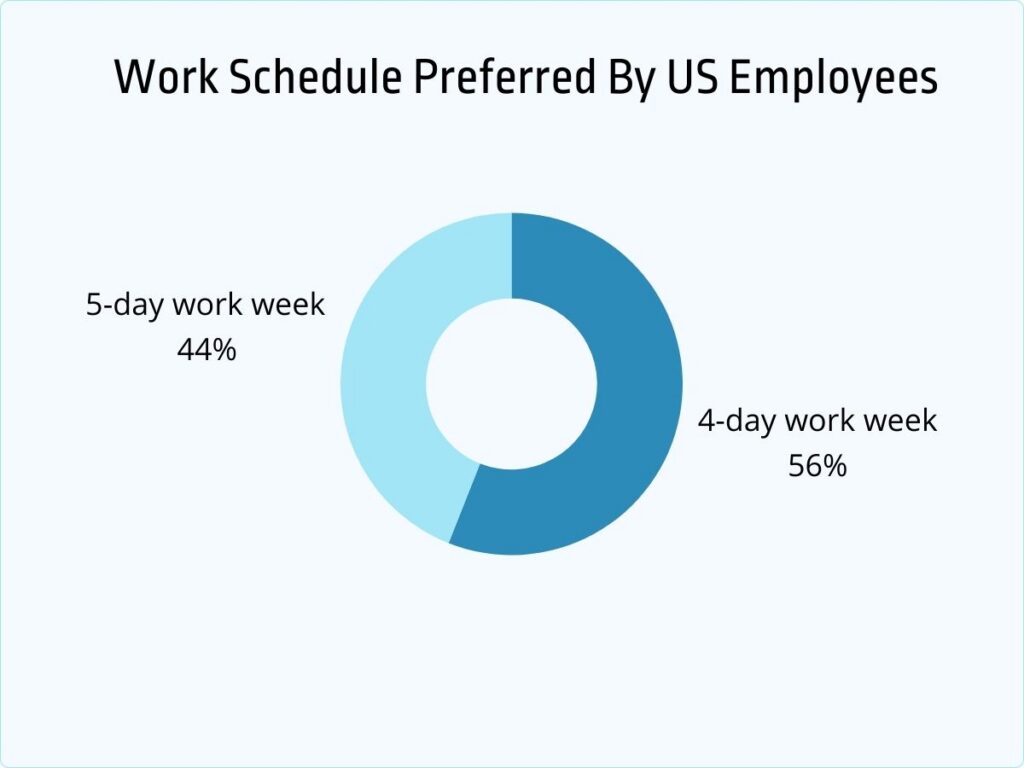
Source: Drive research
Advantages of a 4-Day Work Week
Why do employees prefer a 4-day work week, even though they have to work 10 hrs per day?
According to a study by Henley Business School, 77% of workers reported increased productivity when working a 4-day week. [4]
66% of employees are attracted to job opportunities with a shorter work week. [6]
78% of employees believe that a shorter workweek improves their work-life balance. [7]
Employees who had a 4-day workweek reported lower stress levels and higher job satisfaction. [9]
After the switch to a 4-day workweek, employees in a study took 25% fewer sick days. [9]
Microsoft Japan implemented a 4-day workweek experiment and saw a 40% boost in productivity compared to the previous year. [5]
New Zealand’s Perpetual Guardian company reported that employees’ stress levels decreased by 7% while job satisfaction increased significantly after implementing a 4-day workweek. [8]
Disadvantages of a 4-Day Work Week
It is important to weigh both pros and cons before going into it.
Let’s dive into the disadvantages of a 4-day workweek.
- 62% of businesses stated that implementing a 4-day workweek would require a reduction in employee salaries. [10]
- 39% of employees expressed concerns about a shorter workweek leading to a decrease in income.
- 40% of employees worried about their workload becoming unmanageable within a shorter workweek.
- 44% of HR professionals expressed concerns about the feasibility of a 4-day workweek in their respective industries.
- 46% of HR professionals are concerned about coordinating schedules and managing coverage during the transition into a 4-day work week.
4-Day Work Week Trends and Predictions

It is estimated that 80% of businesses will adopt a more flexible work schedule, including shorter work weeks by 2025. [11]
64% of business leaders expect the 4-day work week to become the norm within the next decade. [12]
Studies suggest a 4-day workweek could lead to increased employment opportunities and improved work-life balance in the future. [13]
If you found this article interesting, you might enjoy these too:
[related_posts_by_tax taxonomies=”category,post_tag” posts_per_page=”5″ orderby=”post_modified” title=””]
FAQs
What is a 4-day workweek?
A 4-day work week is an alternative work schedule in which employees work for four days, about 32 to 40 hours, instead of the traditional five days a week, without a reduction in pay.
What are productivity statistics for a 4-day work week?
According to a study by Henley Business School, 77% of workers reported increased productivity when working a 4-day week.
Are there health benefits to a 4-day workweek?
76% of employees believed that a shorter workweek would improve their mental health and overall well-being.
A study by the SHRM revealed that 63% of HR professionals believed a 4-day workweek would enhance work-life balance for employees.
After the switch to a 4-day workweek, employees in a study took 25% fewer sick days.
Which countries have a 4-day work week?
Iceland, Germany, and Spain have implemented a 4-day workweek to the highest levels.
Final Thoughts
A 4-day work week is an alternative work schedule in which employees work for four days, about 32 to 40 hours, instead of the traditional five days a week, without a reduction in pay.
A 4-day work week is beneficial as according to a study by Henley Business School, 77% of workers reported increased productivity when working a 4-day week. 66% of employees are attracted to job opportunities with a shorter work week.
78% of employees believe that a shorter workweek improves their work-life balance. While 39% of employees expressed concerns about a shorter workweek leading to a decrease in income, 64% of business leaders expect the 4-day workweek to become the norm within the next decade.
Sources
- The hill. 33% of organizations tested 4-day week
- Market research company. Global market for 4-day workweek
- YouGov. Most Americans prefer 4-day work
- Henley Business School. The four-day week
- NPR. 4-day workweek boosted productivity
- Robert Half. Effective employee retention strategies
- Maryville.edu. Shorter Workweek: Pros and Cons for Employee Productivity
- Perpetual Guardian. Work less, get more: New Zealand firm’s four-day week an ‘unmitigated success’
- Harvard Business School. What leaders need to know before trying a 4 day work week
- SHRM. The Phenomenon of the Four-Day Workweek
- CNBC. ‘I would never go back’: Why people love the 4-day workweek, which companies are hiring, and more
- Diverse Research. Improve Employee Wellbeing With These 7 Strategies
